


The Broken Learning Loop with LLM Agents in Crypto
If you’ve spent any time building with Cursor, Claude Code, Codex, or Openclaw, you’ll realize the hardest part of coding is not the writing and running the code, but the planning and validation that comes at each step of development.
Building in crypto makes this problem 10x more apparent due to the unbounded, adversarial nature of blockchains. Most of the time, agents are working in a bounded box - your codebase is all yours, and only updated by you. Blockchains are shared codebases that everyone constantly adds to and commits to. What’s true about the “code” and states now might not be in the next minute. This has been coined as the “dark forest” nature of crypto.
The good thing is that there are already thousands of examples of whatever you want to do onchain, for your agent to enhance your plan and validate it against real transaction data. But these are not laid out in clean end-to-end user journeys. They’re broken up across millions of transactions, contracts, and wallets - and you just have to know how to search and piece them together.
However, your agent can’t just “web search” for addresses either, because they can easily be misled into the wrong contracts, outdated documentation, or missing edge cases. This leads to brute-forcing with many assumptions about the blockchain, and there is no way to create a learning test loop to help with planning or validation. In crypto, that could mean your or your customers’ money is at risk. Searching and learning about protocols is typically done by very technical researchers/devs opening 50+ tabs of different tools like Etherscan, Dune, Blocksec, docs, and Github pages - but not anymore!
Agents are missing a crypto “web search” tool
Web search tools help agents search and extract relevant information from docs, GitHub repos, and more. Given 50 relevant sources, it can probably triangulate on the right answer. Smart contracts are different - if the agent finds 50 addresses, then it’s likely to go down a very wrong rabbithole. Herd’s tools help agents navigate precise relationships when starting from any contract, transaction, or wallet:
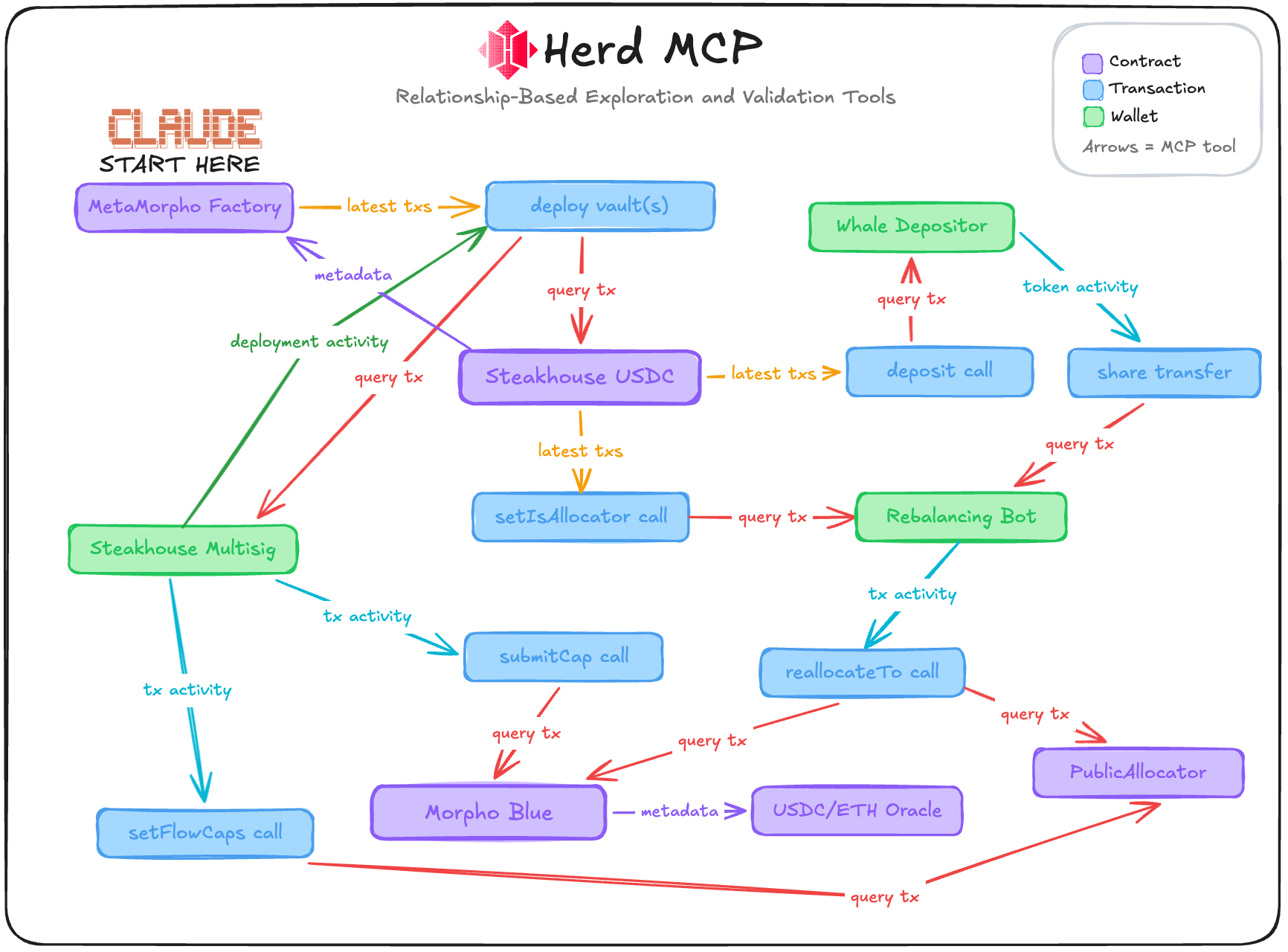
You can think of it as building a relationship graph on the fly - the difference being that we aren’t hardcoding what a “node” or “relationship” is because you can’t really categorize all onchain objects that cleanly (many of us have tried). Instead, we let the agent build a knowledge graph tailored to the task at hand.
Herd has built the most searchable and human-readable Ethereum block explorer over the last year, and we’re now releasing an MCP that includes all the functionality of our explorer (and more). It’s a set of tools focused on navigating the “unknown unknowns” of onchain relationships, with lookup functions for every transaction type to enhance planning and QA validation. It also includes bookmarking tools that let you easily reference the same contracts, wallets, and transactions across chats.
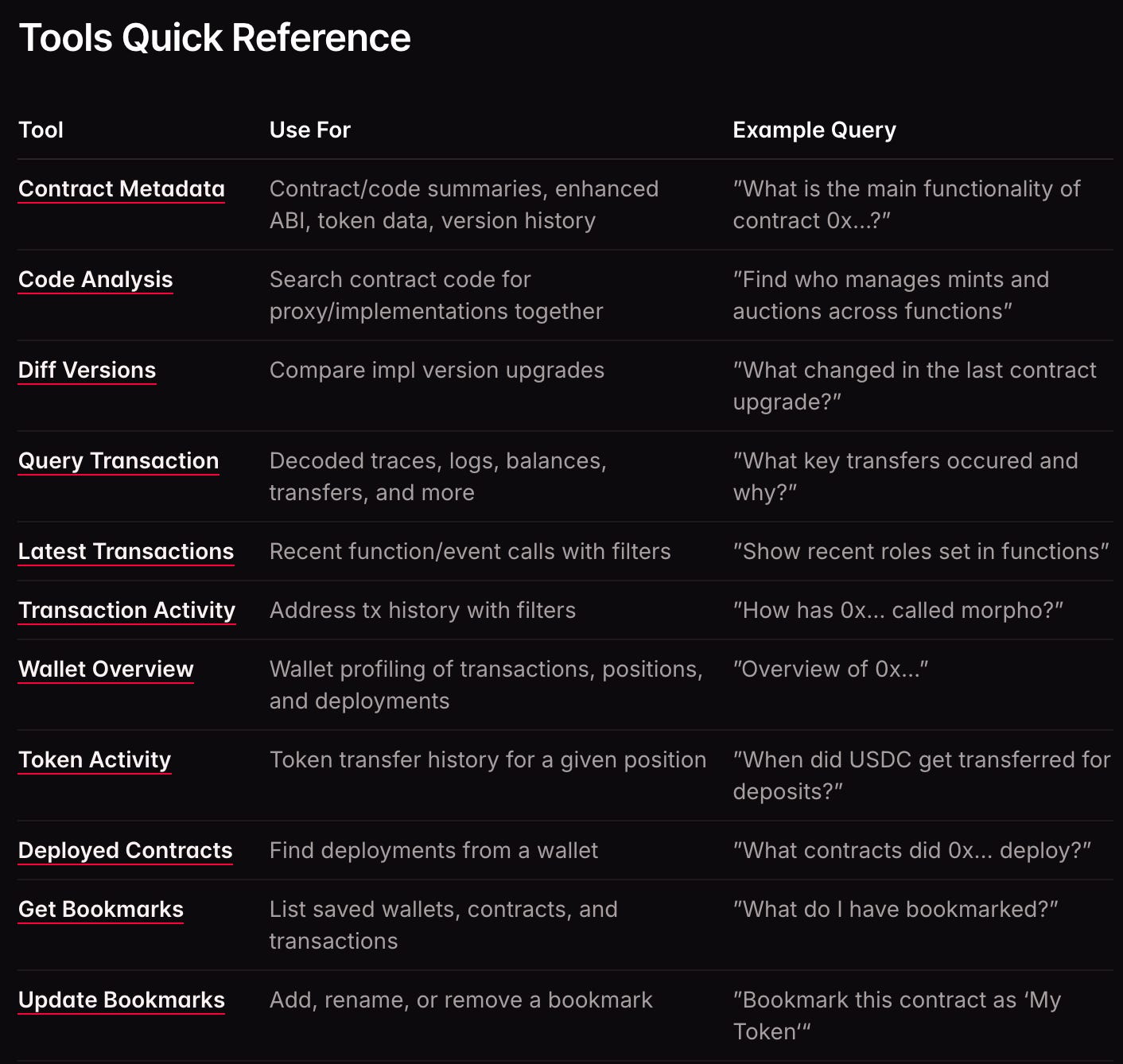
On top of relationship lookups, our tools contain some of the most in-depth contract and transaction data in the industry, combining our own data engineering with 10+ top SDKs and APIs in the space. We also support analysis for all types of wallets: EOA, 4337, 7702, multisig - you name it.
⚙️ To install the MCP “claude mcp add --transport http herd-mcp https://mcp.herd.eco/v1”.
How to Leverage the Herd MCP as a Builder
Let’s walk through developing something in crypto (a data pipeline/query, transaction script, miniapp, etc) using an agent. You must guide the agent through four phases:
(1) 🗺️ Research: Think of this as going wide to find the right contracts to call/analyze. There are many “unknown unknowns” that may not be documented. What’s the user journey through the contract? Who can participate during the journey, when, and through what contracts? Here are some example questions:
Tell me about USDC on Ethereum. Who is handling minting? Can you check the last few mints?
Find the basenames registration contract on Base. Can you figure out what contracts are called during registration? Which contracts can be called to mint basenames, and how is this managed?
Look up the steakhouse morpho vault on ethereum. What are the key functions called by users versus other roles in the contract? What’s the market structure under the vault - where are those tokens located? Who can move those tokens?
(2) ✍️ Planning: Once you have a complete set of contracts to build on, it’s time to go “deep”. Here, you want to focus on studying wallets to understand different user patterns and to look for edge cases in transactions that help break any assumptions the agent makes.
Given the steakhouse multisig, analyze how they interact with their steakUSDC vault. How does this compare to how the Gauntlet multisig interacts with the vault? At each state, what read functions or queries would you write to understand the allocation queue?
Looking at the Nouns contract, analyze how the last five auction winners interact with the token after receiving the token. Are there any interesting patterns in how/where they transfer the token to (i.e. either trading or cold storage)?
(3) 🤖 Implementation: This is when you let the agent do its thing with code. You should enable more skills and MCPs at this point to help with its development cycles. Here are some good ones to add:
Dune Analytics or Allium for SQL queries (MCP)
(4) ✅ Validation: Finally, you want to catch hallucinations or mistakes. You can do this by comparing historical onchain data to the outputs produced by your code. You can ask “Use Herd to look up relevant transactions based on our code, and check that the historical transaction results data matches the outputs from what we’ve built.” Some of these transactions likely already surfaced during the research/planning process, but it helps to explicitly tell the agent to check again.
Having the agent do this and document it also provides you with a reference you can share to help others build confidence in your/the agent's work, too.
🤫 Herd is experimenting with tools that let you create modular actions and queries for simulating, transacting, and reading from the blockchain. DM/email me if you are interested in trying this out.
Now you’re ready to go and safely build in crypto with your favorite agents/LLMs! You can always reach out to me at andrew@herd.eco or andrewhong5297 on Twitter and Telegram for any questions or feature requests.